(
)
The Information Architecture Trap: Why 'Good Enough' Navigation Wins the Conversion Game
Paul Boag recently hit on something that most Growth and Marketing teams won't admit: we're spending weeks debating navigation structures that only represent one slice of how people actually find things.
The perfect IA you're endlessly workshopping? It's probably costing you more in delayed revenue than a "good enough" structure that shipped three months ago.
Here's the uncomfortable truth: your visitors don't care about your org chart, your internal product taxonomy, or which VP won the label naming debate. They care about finding what they need fast enough to stay on your site. And they're using a lot more than your main nav to do it.
Why Do Smart Teams Get Stuck Debating IA for Months?
Growth and Marketing teams confuse "strategic" IA work with endless perfectionism. The real trap isn't bad navigation: it's the belief that your nav structure alone determines findability success.

The anxiety is real. You're staring at a Figma file with seventeen different navigation proposals, and someone just asked, "But what if a user is looking for X and we filed it under Y?" Cue another two-hour meeting.
This happens because most teams treat IA like it's 2006. Back then, your navigation was your primary discovery mechanism. Search was clunky, internal linking was an afterthought, and homepage real estate was precious. Getting the nav "perfect" actually mattered more.
But here's what's changed: your website now has multiple, parallel discovery systems working simultaneously. Your main navigation is just the most visible one: not necessarily the most used one.
The "template trap" compounds this problem. Research shows that roughly 80% of sites in the same industry end up with nearly identical navigation structures: "Solutions," "Services," "About," "Resources." Teams copy competitors because it feels safe, then spend months debating micro-variations that don't meaningfully differentiate their experience.
The real cost? Every week you spend perfecting your IA is a week you're not collecting actual user behavior data. You're optimizing in a vacuum, making decisions based on internal politics and gut feelings rather than the performance signals that actually drive Growth and revenue.
What Are All the Ways People Actually Find Things on Your Site?
Navigation is one discovery path among many. Search, cross-links, landing pages, and homepage features often outperform your carefully crafted nav: especially for high-intent visitors.
Your analytics will tell you a story your IA debates won't: most converting visitors don't methodically click through your navigation hierarchy like you planned.
Search Is Carrying More Weight Than You Think
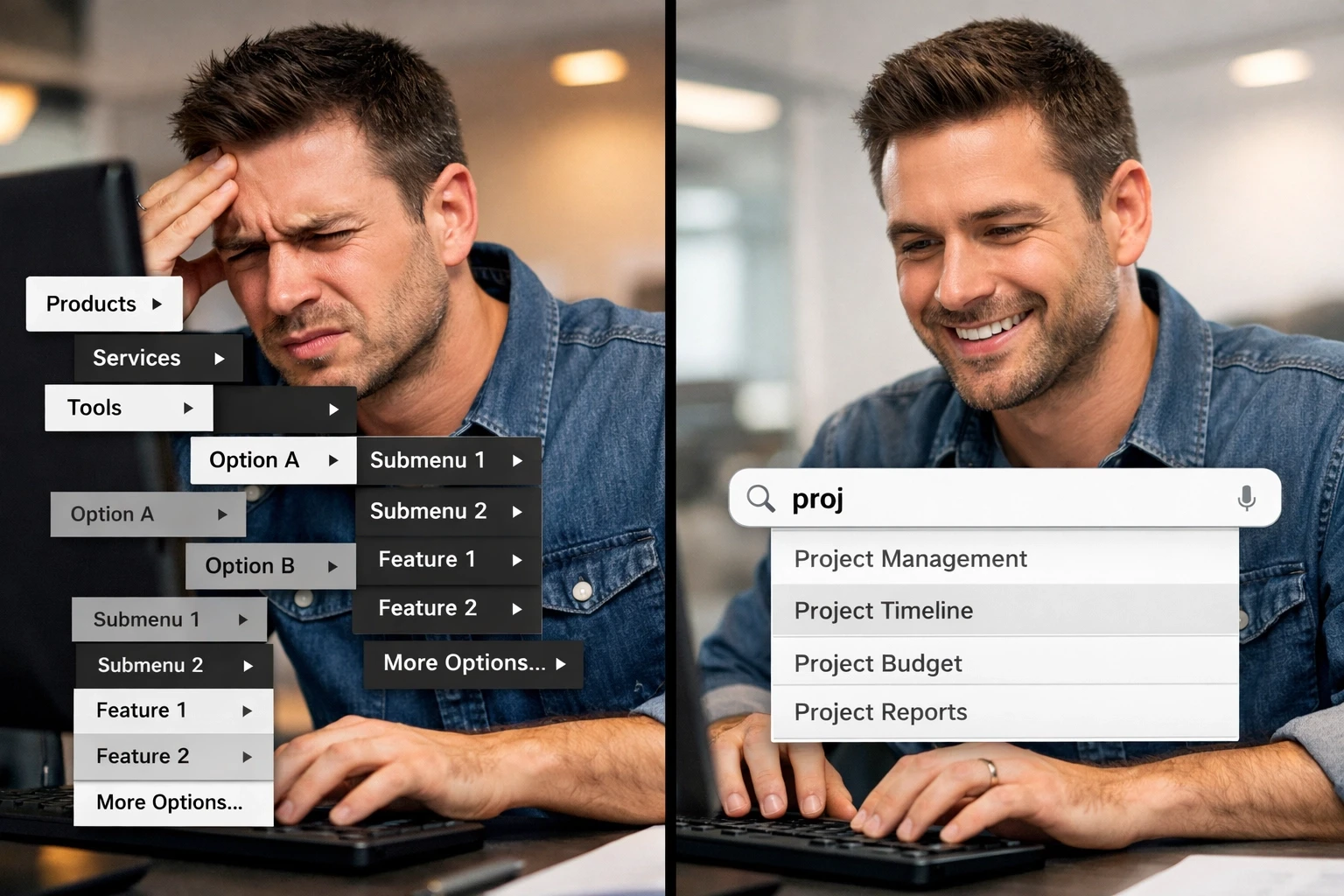
Site search users convert at 2-3x the rate of non-searchers. Why? Because they already know what they want. They're not browsing: they're hunting.
If someone lands on your site and immediately searches "pricing," they've told you exactly where they are in the buyer journey. Your nav structure could be perfect, but they've already bypassed it. The quality of your search functionality and results page matters infinitely more than whether "Pricing" lives under "Solutions" or stands alone in the top nav.
Cross-Linking Creates Infinite Navigation Paths
Your internal linking strategy might be the most undervalued discovery mechanism you have. When someone reads a blog post about coffee sourcing and ends up clicking into your subscription plan page, that's a navigation path. When a visitor skims a “How it works” page and clicks into your “Subscribe & save” checkout, that’s another path.
Strategic cross-linking means you're not forcing people through your predetermined hierarchy. You're creating organic pathways based on intent and context—so more visitors self-qualify into the pages that actually drive revenue. LinkStorm’s internal links research cites that 64% of successful conversions involved at least one contextual internal link (i.e., not part of the main navigation): https://linkstorm.io/studies/internal-links-study
Landing Pages Bypass Your IA Entirely
If you're running any paid acquisition, your landing pages are probably your highest-traffic entry points. These visitors never see your homepage or your carefully debated navigation structure. They land on a campaign-specific page designed to convert on a single offer.
Your IA debates are completely irrelevant to this traffic. What matters is the scent trail: does the landing page deliver on the ad promise? Does the CTA align with their search intent? Can they find proof points without hunting?
The Homepage Is a Promotion Engine, Not Just a Nav Hub
Your homepage features, hero sections, and promotional blocks are active navigation elements. They're algorithmic (showing different content to different segments), promotional (highlighting seasonal offers), and strategic (pushing visitors toward high-value journeys).
When someone clicks a homepage callout promoting "Free Growth Audit," they've navigated: just not through your main menu. These dynamic elements often drive more qualified traffic to key pages than your static nav ever will.
How Do You Know When Your IA Is "Good Enough" to Ship?
Ship when your IA uses customer language, supports your top 3 conversion paths, and doesn't actively confuse people in a usability testing session. Perfect can wait.
Here's your gut-check framework:
The Language Test: Read your navigation labels out loud. Would your actual customers use these exact words when describing what they're looking for? If your nav says "Enterprise Intelligence Solutions" but your sales calls are full of people asking for "business analytics software," you've failed the language test.
This isn't about dumbing things down: it's about eliminating the translation layer between how you think internally and how customers search externally. Strategic IA uses customer language discovered through sales transcripts, support tickets, and search console data.
The Priority Test: Can users reach your three most important conversion paths within two clicks from any major entry point? If your goal is demo requests, content downloads, and consultation bookings, can people get there fast? Your IA should grease the rails for your business priorities, not showcase your complete product taxonomy.

The Confusion Test: Run a quick usability testing session: even an informal one with five people. Ask them to find three specific things using your nav. If more than one person gets confused or clicks the wrong section, you've spotted a real problem worth fixing.
But here's the key: if they eventually find it (even through search or cross-links), and your conversion paths are clear, you're good enough to ship.
The Benchmarking Reality Check: Track these metrics for your current (or proposed) IA:
Nav engagement rate: What percentage of visitors actually use your main navigation vs. other discovery methods?
Search usage rate: Higher than 30% usually means your nav isn't doing enough heavy lifting
Top exit pages: If people are bouncing from navigation landing pages, your labels might be misleading
Task completion rate: In usability tests, can people find what they need within 30 seconds?
If you're hitting 70%+ task completion in testing and your bounce rates on key nav-destination pages are below your site average, you're in good-enough territory.
What Should You Do After You Ship Your "Good Enough" IA?
Ship, then watch. Set up analytics, run quarterly usability testing, and adjust based on actual behavior: not opinions. The web isn't permanent.
This is where the "good enough" strategy actually becomes strategic. You're not shipping mediocrity and walking away: you're shipping a testable hypothesis and committing to iteration.
Set Up the Right Tracking
Configure your analytics to answer:
Which nav items get clicked most (and least)?
Where do users go after hitting nav-destination pages?
What percentage of your converting visitors never touched the main nav?
What are your top site search queries?
This data tells you where your IA is working and where it's failing. Tag your navigation clicks separately from other on-page links so you can isolate nav performance in a proper site audit or conversion performance review.
Run Quarterly Usability Testing
Every three months, test your navigation with 5-8 users. Give them realistic tasks: "Find pricing for X," "Locate case studies in Y industry," "Download the Z resource."
Track failure patterns. If multiple people consistently miss something or end up in the wrong place, that's signal in the noise. One confused user might be an outlier. Four is a pattern.

Adjust Based on Behavior, Not Opinions
When someone suggests a nav change, ask: "What data are we seeing that suggests this will improve revenue outcomes?" If the answer is "I just think it would be clearer," table it unless usability testing backs it up.
But when you see patterns: say, 40% of demo requests come from people who used site search, or a particular nav label has a 3x higher bounce rate than others: act on it. These signals are more valuable than any stakeholder opinion.
Keep Testing Your "Hidden" Discovery Paths
Your nav gets attention, but are you optimizing your search results page? Your internal linking strategy? Your landing page experience? Run A/B tests on these discovery mechanisms too.
Try adding related content modules, improving search autocomplete, or creating topic clusters with stronger internal linking. These improvements often yield better ROI than nav restructuring because they compound intent (and accelerate revenue paths) rather than forcing people into your org chart.
Frequently Asked Questions
Doesn't "good enough" navigation hurt SEO?
Not if you're using customer language in your nav labels and creating clear information hierarchies in your HTML. Google cares about crawlability, clear site structure, and relevant internal linking: not whether your IA is "perfect." Shipping a solid nav now beats a perfect nav in six months, especially since you can iterate based on actual search console data.
What if our IA is actually broken, not just imperfect?
Real red flags: bounce rates above 70% on nav-destination pages, usability testing showing consistent confusion, or support tickets asking "where do I find X?" If you're seeing these, your IA needs fixing, not just shipping. But even then, fix the critical paths first and iterate on the rest.
How do we avoid the "template trap" while still shipping quickly?
Do the strategic work upfront: research your customers' actual language, understand your competitive positioning, identify your priority conversion paths. Then apply those insights to a structure that's recognizable enough to not confuse people. Strategic doesn't mean slow; it means intentional.
Should we redesign our entire site or just fix the navigation?
Most sites don't need a full redesign: they need better discovery mechanisms across the board. Start with quick wins: improve search, add contextual cross-links, optimize your highest-traffic landing pages. Navigation is one lever among many in your Growth toolkit.
Ready to Ship Your IA and Start Testing?
Treat IA like a revenue system, not a design artifact. Ship a “roughly right” structure, instrument it, and run a leadership-level review loop that ties discovery to pipeline, AOV, retention, and support load.
Stop debating and start learning. Here’s a tighter executive roadmap:
Align IA to business priorities: Decide the 3–5 journeys that matter most right now (e.g., first purchase, upgrade, demo, retention flows) and make them effortless to find from any entry point
Instrument discovery as a system: Track nav clicks vs. search vs. contextual links so you can see what’s actually driving revenue outcomes
Validate language against demand: Cross-reference labels against real customer language (sales calls, support tickets, Search Console queries like “growth strategies,” “revenue optimization,” and “customer retention”)
Ship with a “good enough” bar: Define success in business terms (fewer dead-end sessions, higher task completion, improved qualified clicks into money pages), not committee consensus
Operate a 30/60/90 review cadence: Revisit IA with the same discipline you apply to pricing, positioning, and paid spend—small adjustments, measured impact, no ego
Your navigation matters—but mostly because it shapes how quickly people get to value, proof, and purchase. The long-term win isn’t a perfect sitemap. It’s an executive decision-making posture: ship, measure, and reallocate attention toward the discovery paths that move revenue and reduce friction quarter after quarter.
More Insights
Explore ideas, tips, and trends to elevate your brand.