(
)
12 CRO Tactics That Convert SaaS Visitors to Customers
If you've been wondering what CRO tactics work best for SaaS websites, the answer starts with a hard look at your funnel data. SaaS companies spend enormous budgets driving traffic to their sites, then watch most of it disappear without converting.
The average B2B SaaS homepage converts just 2 to 5% of visitors into signups. Trial-to-paid rates hover between 12 and 28% for most products, even well-funded ones. Top performers exceed 10% visitor-to-signup and push trial-to-paid past 35 to 40%. That gap isn't a traffic problem. It's a conversion problem.
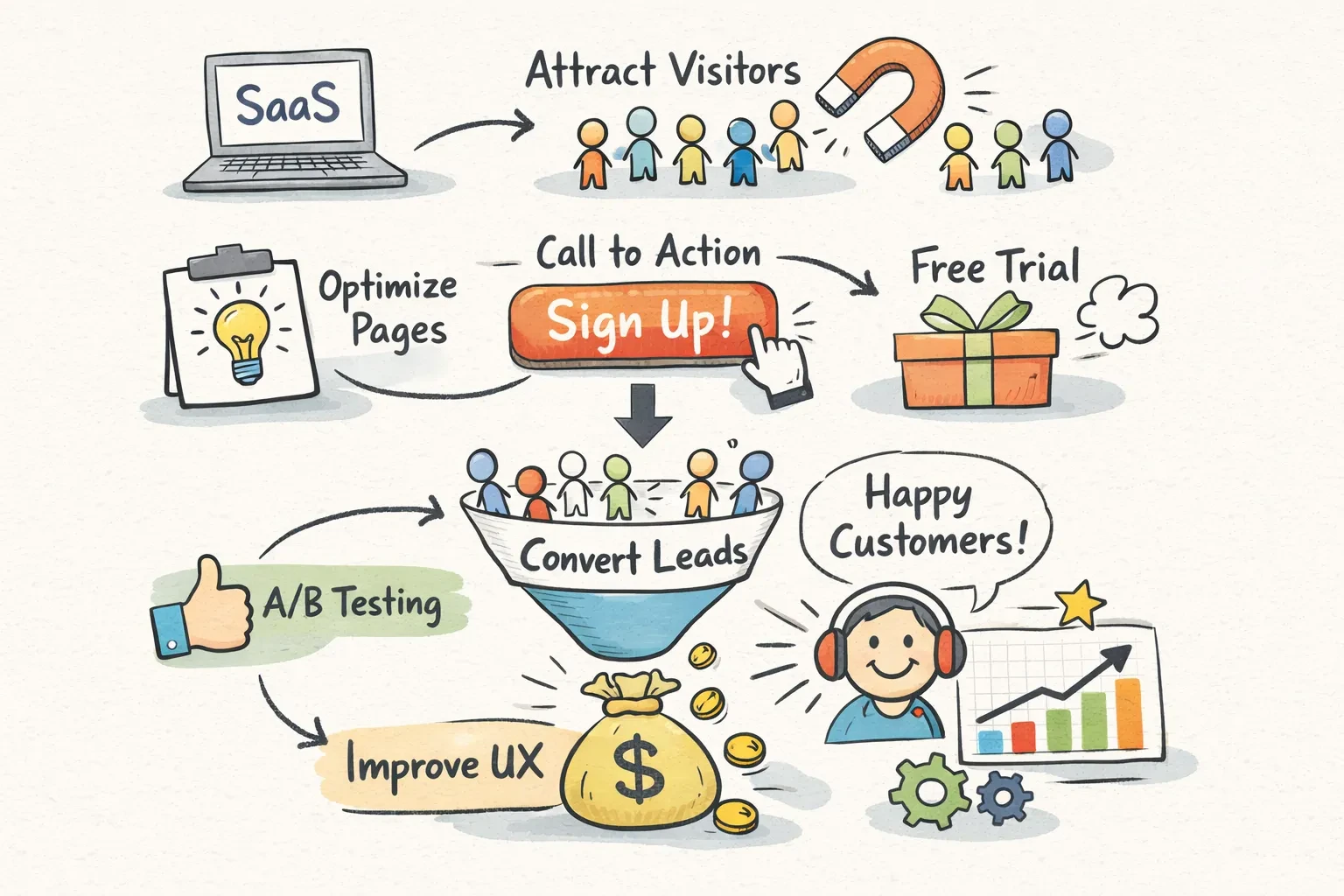
The 12 tactics below are organized by funnel stage and backed by documented lift data from real SaaS experiments. What separates companies that compound these gains from those that get one-off bumps is sequencing: running experiments in a structured order, building on each result rather than testing randomly. That's the recommended approach in this guide, and it's what the prioritization framework at the end helps you replicate.
Each section delivers specific tactics with benchmarks, not general advice repurposed from e-commerce playbooks. The four funnel areas covered are signup flow, pricing page, onboarding, and behavioral triggers.
Where SaaS conversion funnels consistently break
Every SaaS funnel has three critical stages: visitor to signup, signup to activation, and trial to paid. Each stage has its own failure mode, and they compound. Visitor-to-signup loses people to unclear value propositions, slow load times, and friction-heavy forms. Signup-to-activation drops when users don't reach a meaningful product moment fast enough. Trial-to-paid stalls when pricing feels confusing or the upgrade path feels risky.
The benchmark data makes the opportunity concrete. Top SaaS companies convert over 10% of visitors to signups; the median sits at 3.8%. Trial-to-paid elite performers exceed 40%; most companies land below 25%. The difference between those numbers is rarely product quality alone. In most documented cases, the funnel experience surrounding the product is the primary driver of that gap.
Generic CRO advice doesn't transfer cleanly to SaaS because SaaS funnels are multi-touch and logic-driven in a way e-commerce isn't. A tactic that works on a product detail page doesn't automatically apply to a 14-day trial flow with behavioral triggers and in-app messaging. The 12 tactics below are specific to SaaS conversion optimization, built from experiments that have run inside actual SaaS funnels.
What CRO tactics work best for SaaS signup flows
1. Cut your form fields to four or fewer
The evidence here is consistent across dozens of tests. Cutting from 12 fields to 4 pushed one SaaS signup rate from 4.2% to 9.1%. Four-field forms convert at more than double the rate of eleven-field alternatives in documented comparisons. Every extra field adds hesitation at the exact moment a prospect is deciding whether to commit. Ask only for what you need to create an account, nothing more, and defer everything else.
2. Add social login to eliminate the password barrier
Social login consistently produces 40%+ conversion improvements in documented tests. It removes the friction of password creation, reduces form abandonment, and compresses registration to a single click. For B2B SaaS specifically, LinkedIn and Microsoft SSO are worth testing as alternatives to Google, since those platforms align more closely with where buyers spend their working hours. If your signup flow still asks users to create a password before they've experienced any product value, this is your highest-priority fix.
3. Use progressive profiling to collect data after signup
Progressive profiling defers non-essential questions, company size, role, use case, until after the user has signed up and experienced initial value. One CRM SaaS saw a 31% increase in form completion by moving these fields post-login. Collect data contextually, tied to product actions, rather than demanding it at the door. Users who've already invested time in your product answer profiling questions at a far higher rate than new visitors who haven't yet seen any value. For practical signup form tips, see signup form best practices.
Pricing page CRO tactics for SaaS with documented lift
4. Test anchor pricing and tier naming
Server Density achieved a 114% revenue increase by switching from cost-based to value-based pricing. Basekit saw 25% conversion growth by introducing named tiers alongside anchor pricing and consistent CTA buttons. Naming your tiers sets psychological context: when users see "Basic," "Business," and "Enterprise" side by side, the middle option becomes the obvious, rational choice without requiring any explicit recommendation. Anchor pricing makes the premium tier feel expensive and the mid-tier feel like a bargain simultaneously. For inspiration, review these best SaaS pricing page examples.
5. Default to annual billing and let users opt out
ConvertKit increased revenue by more than 30% by defaulting to annual billing rather than monthly. Toggle tests consistently show 25 to 35% increases in annual plan signups when annual is the pre-selected option. Making the billing choice visible through a toggle, rather than burying it, reduces the cognitive load on users who would otherwise miss it entirely. The default state carries disproportionate weight: most users accept it without switching, which means your default setting effectively determines your conversion rate for that dimension.
6. Place social proof directly beside your primary CTA
Social proof near the CTA, not buried in a separate testimonials section, drives 10 to 20% conversion lift on pricing pages. Adding "No Credit Card Required" messaging alone improved conversions by 12.5% in documented A/B tests. Customer logo strips placed near the signup button produce a similar effect, signaling safety at the moment of decision. Proof is most powerful when it appears where hesitation lives, not three scrolls away from the button.
Onboarding experiments that close the activation gap
7. Personalize the first-run experience by use case
Generic onboarding treats every user the same regardless of their role, goal, or context. Personalized onboarding adapted from a brief intake survey has been shown in multiple SaaS studies to significantly improve Day 30 retention relative to generic flows, with some documented tests reporting retention lifts above 50%. A straightforward implementation uses a two-question onboarding survey to route users to a tailored checklist matched to their stated goal. Reducing onboarding steps from five to three increases activation probability meaningfully, so shorter and smarter consistently beats longer and thorough.
8. Replace static product tours with interactive walkthroughs
Interactive onboarding flows tend to outperform static tutorials or video-only tours on activation metrics. Rather than watching a demo, users complete real actions inside the product, which builds investment faster. Research from multiple PLG-focused SaaS studies suggests contextual, in-product prompts drive meaningfully higher feature adoption than upfront tutorials delivered before users have any stake in the outcome. The shift from passive to active onboarding is one of the highest-leverage changes available in a product-led growth funnel.
9. Add a gamified onboarding checklist with visible progress
Onboarding checklists with completion indicators and milestone moments increase 7-day retention by 40 to 60% compared to funnels without progress signals. The psychological mechanism is the goal gradient effect: users accelerate toward completion as they see the finish line approaching. Keep the checklist short, aim for five items or fewer, to avoid overwhelming new users before they've built any habit around your product. Every item should map to a specific activation milestone, not a feature demonstration.
Behavioral triggers and social proof that move hesitant users
10. Replace broadcast emails with behavior-based sequences
Behavior-based email triggers produce 4.5x higher engagement than scheduled broadcast campaigns. Instead of sending a "Day 3 of your trial" email on a fixed cadence, fire messages based on what a user did or didn't do: visited the pricing page, completed setup but didn't invite a teammate, logged in twice then went quiet. Re-engagement campaigns tied to behavioral signals recapture 15 to 25% of users who dropped off during onboarding, a substantial recovery of users your product already paid to acquire.
11. Use in-app nudges tied to intent signals
In-app messages triggered by pricing page visits, feature limit encounters, or inactivity thresholds are among the highest-leverage moments to present an upgrade prompt. These contextual nudges consistently outperform scheduled pop-ups in documented PLG tests because they reach users when friction or consideration is already present, not when it's convenient for the calendar. A user who just hit a usage limit is measurably more receptive to an upgrade message than the same user receiving a generic Tuesday afternoon email, and that timing difference is what separates effective upgrade flows from ones that feel like interruptions.
12. Treat page speed as a direct conversion lever
A 1-second load time produces 3x higher conversions than a 5-second load, according to Portent research. Each additional second shaved off mobile load time improves conversions by 3%. The average SaaS mobile page loads in 8.6 seconds against an optimal threshold of 3.5 seconds, which means most SaaS sites are leaving measurable conversion volume on the table before a visitor reads a single word. Speed improvements are among the highest-ROI fixes available in a SaaS growth program, and unlike most UI changes, their impact can often be validated through direct performance monitoring rather than traditional A/B testing. Read more on the impact of speed on conversions at page speed and conversions.
How to prioritize these 12 tactics and run your first experiments
Not all 12 tactics deserve equal urgency. Score each one on three variables: estimated impact on a core metric, implementation effort, and confidence based on existing data in your funnel. Multiply the scores, rank the output, and start with the top three. Run each test for at least two to four weeks before drawing conclusions, and resist the temptation to call tests early when promising data appears in the first few days. If you need test ideas, check this list of A/B tests.
A simple prioritization framework looks like this:
High impact, low effort: Social login, form field reduction, "No Credit Card" messaging, annual billing default
High impact, moderate effort: Behavioral email sequences, interactive onboarding walkthroughs, pricing tier restructuring
High impact, higher effort: Personalized onboarding flows, full pricing page redesign with anchor pricing
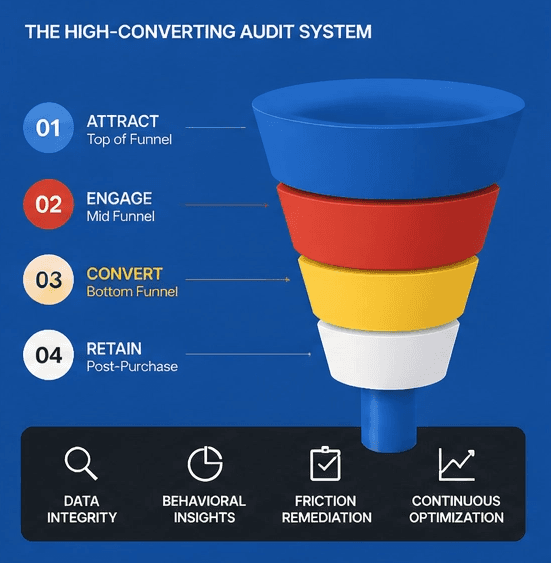
Running these tactics in isolation produces one-off lifts. Running them as part of a structured experimentation program, with proper tracking, hypothesis documentation, and phased rollout, is what produces compounding growth. At DEUX Labs, this is how we approach SaaS CRO: starting with a comprehensive funnel audit to surface the highest-impact opportunities, then sequencing experiments in a structured four-step process that builds on each result. If you want to start this week, the free CRO Playbook walks through the first audit in practical, no-fluff steps.
The conversion gap is a fixable problem
When it comes to what CRO tactics work best for SaaS websites, the answer is always context-dependent, but the pattern is consistent. The difference between a 3% trial-to-paid rate and a 35% one is more often a conversion and funnel experience gap than a product gap, and in most cases it's addressable with structured experimentation. The 12 tactics covered here target every major leak point in a SaaS funnel, from the signup form to the upgrade nudge, each backed by documented lift data rather than best-guess advice.
The path forward is concrete: reduce friction at signup, run structured pricing page experiments, shorten and personalize onboarding, and deploy behavioral triggers at the moments that matter most. Use the prioritization framework to sequence these into a 90-day experimentation roadmap rather than attempting everything at once. That sequencing is the difference between compounding gains and a list of tactics that never get implemented.
If you're ready to move from tactics to a structured program, DEUX Labs offers a free funnel audit for SaaS teams who want to identify their highest-impact opportunities before writing a single line of test code. Start there, and the roadmap builds itself.
More Insights
Explore ideas, tips, and trends to elevate your brand.