(
)
The UX-to-Conversion OS Self-Diagnostic: 8 Symptoms of a Broken Conversion Process
Most growth teams aren’t short on ideas. They’re stuck inside a conversion process that looks busy on the surface but keeps hiding the real reason growth has stalled.
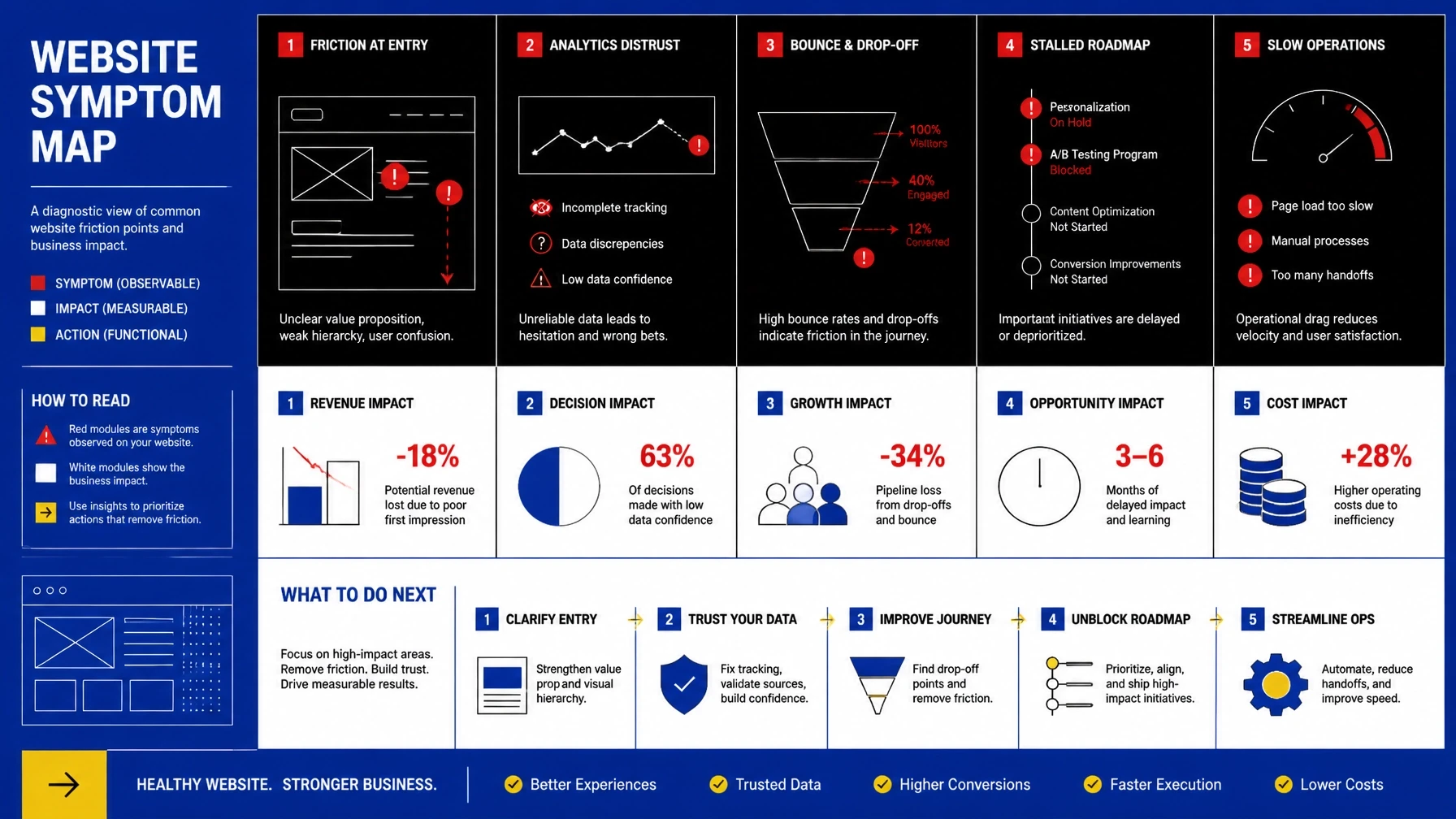
That’s the core job of a UX-to-Conversion Operating System (OS): to surface the hidden growth constraints sitting between your traffic investment and your actual revenue outcomes. When the OS is weak, the symptoms show up everywhere, from bad reporting to slow execution to random roadmap decisions.
If you’re a founder, CMO, or Head of Growth seeing traffic come in without enough return on the P&L, this lite diagnostic is for you. These eight symptoms help you spot where your conversion engine is breaking down without giving away the full deep-dive framework behind it.
Are your marketing wins failing to show up on the P&L?
You can hit channel goals and still feel like the business isn’t actually healthier. Paid social can be up. CAC in-platform can look decent. Lead volume can rise. But if revenue quality, contribution margin, or trial-to-paid conversion isn’t moving with it, you’re dealing with a hidden growth constraint.
This usually means your marketing activity and your business outcomes aren’t properly connected. The issue isn’t that your team is doing nothing. It’s that the system translating traffic into value is leaking somewhere between click and conversion.
For DTC brands, that often shows up as strong top-line traffic with weak checkout completion, low repeat rate, or margin erosion. For SaaS, it can look like decent demo volume paired with weak activation or poor pipeline quality.
Do you feel like you can’t trust your own analytics data?
When your analytics, ad platform, and backend numbers all tell slightly different stories, decision-making slows down fast. You hesitate to scale what’s working because you’re not fully convinced the signal is real.
That lack of trust becomes a growth constraint on its own. Teams stop making confident bets. Roadmaps get softer. Every result turns into a debate about instrumentation instead of a conversation about action.
Broken attribution, duplicate events, GA4 setup issues, cross-device gaps, and CRM mismatches are common culprits. If you don’t trust the signal, you can’t build a reliable conversion process on top of it.
Do you know what is happening but still have no idea why?
This is one of the most common traps in growth. You know users drop on pricing. You know mobile converts worse than desktop. You know checkout abandonment is high. But you still can’t explain the behavior with enough clarity to make the next move obvious.
Knowing what without knowing why keeps teams stuck in tactical loops. You end up shipping fixes based on instinct, internal opinions, or competitor copying instead of actual user understanding.
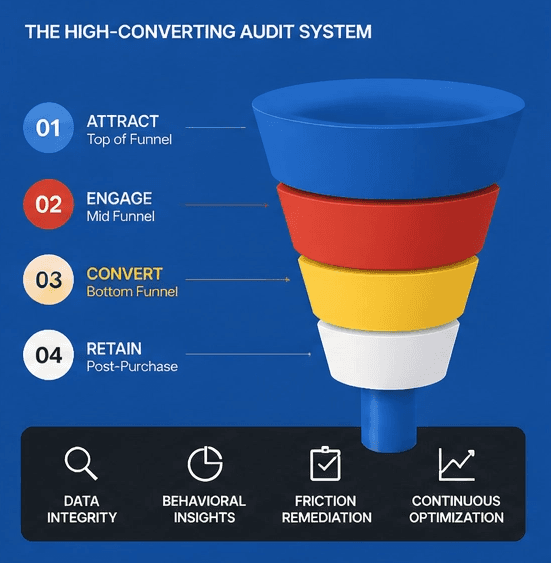
This is where customer research, survey data, session review, call analysis, and usability testing matter. If you can’t clearly name the objections, anxieties, or unanswered questions blocking conversion, you’re still diagnosing the dashboard, not the engine. For a related breakdown of how to structure that analysis, see The Anatomy of a High-Converting Audit.
Are users bouncing while the real psychological barriers stay invisible?
A bounce rate spike doesn’t tell you much on its own. It tells you friction exists, not what form it takes.
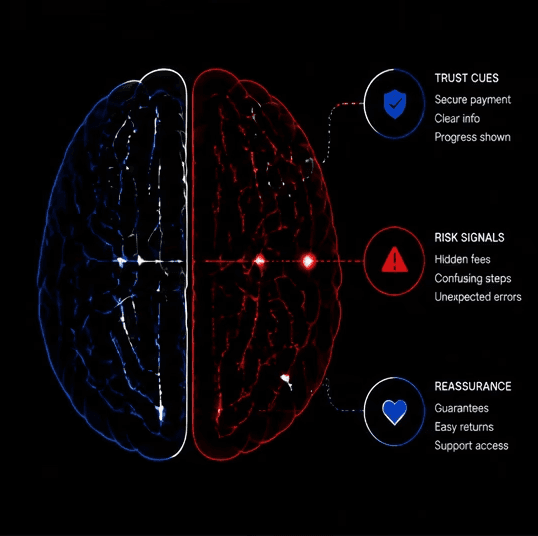
The real issue is usually psychological: weak clarity, low trust, poor message match, overloaded interfaces, premature asks, or uncertainty about what happens next. Those are the walls users hit before they ever articulate them.
On high-intent pages like product detail, pricing, or checkout, these hidden barriers are expensive. If your team is only reviewing surface metrics and visual design, you’re missing the deeper reason people hesitate. That’s why conversion work has to go beyond layout tweaks and into user psychology. You can see that principle in action in our case study with Kiva, where trust and proof signals played an outsized role.
Is your roadmap basically a best guess shaped by the loudest voice in the room?
If your next sprint is driven by stakeholder opinions, isolated customer comments, or whatever feels easiest to ship, your roadmap isn’t really a roadmap. It’s a queue of guesses.
That’s a serious symptom of a broken conversion process because prioritization is what determines whether effort compounds or gets wasted. Without a consistent decision model, high-leverage fixes get buried under low-impact work.
Frameworks like PIE (Potential, Importance, Ease) and ICE (Impact, Confidence, Ease) help because they force trade-offs into the open. They don’t remove judgment, but they do reduce randomness. If your team can’t explain why one initiative beats another in business terms, there’s probably a hidden constraint in how decisions get made.
Are you changing things without moving your North Star metric?
Lots of teams ship changes. Far fewer can prove those changes mattered.
If pages get redesigned, copy gets rewritten, flows get rebuilt, and your North Star metric still sits flat, that’s a strong sign your validation process is weak. Activity is happening. Learning isn’t.
Sometimes the issue is sample size. Sometimes it’s poor test design. Sometimes the change was real but the metric wasn’t the right one to watch. Either way, if you keep shipping without reliable validation, your team starts confusing motion for progress. That’s where many SaaS conversion strategies lose credibility internally.
Does it take weeks of meetings just to change one headline?
When execution is slow, your conversion engine loses tempo. Even obvious fixes get trapped behind approvals, resourcing issues, dev queues, brand review, or internal politics.
That’s not just annoying operationally. It directly affects growth because speed is part of how a healthy UX-to-Conversion OS learns. The longer it takes to launch changes, the longer it takes to generate signal, and the harder it becomes to build momentum.
If one headline update turns into three weeks of meetings, your issue isn’t just copy. It’s process design. That’s usually a sign that execution infrastructure hasn’t been built to support optimization as an ongoing capability.
Does every month feel like starting from scratch again?
When teams don’t capture what they’ve learned, every cycle begins with the same debates. The same ideas resurface. The same objections get rediscovered. The same experiments get reframed as if nobody has seen them before.
That creates a hidden tax on growth. Instead of compounding insight, your team burns time rebuilding context. Over time, this slows decision-making, weakens strategic confidence, and makes optimization feel more random than it actually is.
A healthy UX-to-Conversion OS turns learning into institutional memory. If your team can’t quickly pull up what messaging worked, what segments responded, or which tests produced meaningful insight, you’re not building a capability yet. You’re just repeating effort.
How to Get Started: Run a Lite Diagnostic First
You don’t need a massive transformation project to spot the problem. You need a clearer read on where the hidden growth constraints are sitting inside your UX-to-Conversion OS.
Start here:
Check whether channel wins are improving a real business outcome, not just platform metrics.
Audit whether your analytics, CRM, and backend data actually agree.
Document the top reasons users hesitate, abandon, or delay.
Review high-intent pages for trust gaps, clarity issues, and psychological friction.
Pressure-test your prioritization process against ICE or PIE instead of opinion.
Separate shipped changes from validated wins tied to a North Star metric.
Map where approvals, dev bottlenecks, or cross-functional process are slowing execution.
Capture learnings centrally so each month builds on the last one.
If more than three of these symptoms feel familiar, there’s a good chance your growth is being throttled by hidden constraints in the system rather than a traffic problem.
If you want the full Deep-Dive Diagnostic, reach out to Stan or the Sales team for the gated version.
Optimization isn't a project; it’s an operating system. When the system is constrained, growth stalls. When the system gets clearer, decisions get a lot easier.
More Insights
Explore ideas, tips, and trends to elevate your brand.